
What Otsego Deed Records Show
The Register of Deeds records every instrument that transfers or burdens real estate in Otsego County. Each recorded deed shows the grantor, the grantee, the legal description, the instrument date, the recording date, and a liber and page reference. That reference proves the document entered the public chain. It does not prove the title is clean. A recorded deed is evidence of a transfer, not a guarantee that no other claims exist, so read the surrounding records before drawing conclusions about ownership.
| Deed Type | What It Does | Common Use |
|---|---|---|
| Warranty deed | Conveys an interest with stated title promises | Conventional property transfer |
| Quitclaim deed | Conveys whatever interest the grantor has | Family or title-cleanup transfer |
| Trustee or representative deed | Transfers through an authorized fiduciary | Trust or estate matter |
| Sheriff or court-related deed | Records a transfer tied to legal process | Court-directed transfer |
| Tax-related deed | Records a transfer following the applicable tax process | Delinquent-tax property |
Mortgages and liens are encumbrances, not deeds. Each one asserts a claim or burden tied to the land. Each also sits in the deed index alongside the transfers. Assignments, discharges, and releases show what happened to those claims later. Read the full sequence. Only then can you judge the parcel. That tells you whether an old mortgage or lien still matters for the parcel.
Otsego Deeds Since 1864
Otsego County publishes a clear coverage statement. Deed indexes and images run from March 5, 1864 to the present. Images can be purchased online. Any record can be retrieved or copied at the office. That is a deep archive. It still is not a promise that every early instrument is viewable from home. The Archives of Michigan guide adds useful detail. It lists Otsego deeds from 1863 through 1922 and deed indexes from 1867 through 1900. It also lists mortgage indexes from 1875 through 1900, and a tract book covering 1875 through 1885. A chain may reach the first year of county coverage. It may need an archival index and a requested copy for its next link.
Note: Record whether a citation refers to an index entry or to the complete recorded instrument.
When Otsego's Portal Fails
The county's online recorder portal does not always load, and a failed search is not a dead end. The official Register of Deeds page is the reliable route. The office sits at 225 W Main Street, Gaylord, Michigan 49735, and answers the phone at 989-731-7550. Staff do not run general searches, so arrive with an owner name, tax ID, approximate date, legal description, or recording citation. Equalization can connect a tax ID or owner to the parcel before the deed work begins.
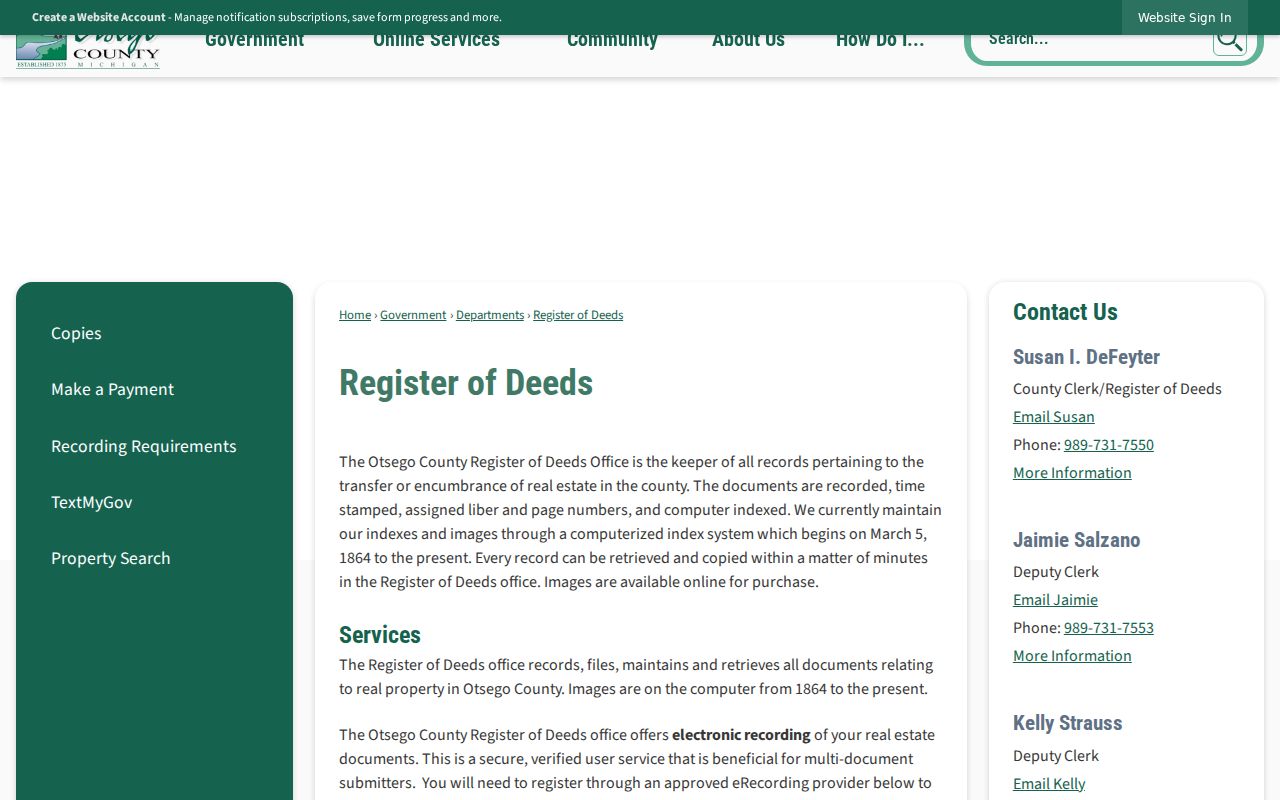
The Register of Deeds page states the office's official coverage range and its access route.
Read Otsego's Party Index
A grantor gives up an interest in the parcel. A grantee receives it. To trace a chain of title in Otsego County, start with the most recent deed you know and work backward, using its names, legal description, and recording citation to locate the prior link. Names alone are a weak thread, because the same person can appear in instruments that have nothing to do with your parcel.
- Find the latest purchase deed with the current owner shown as grantee.
- Copy the grantor, legal description, instrument date, recording date, liber, and page.
- Search that grantor as an earlier grantee, then verify the same land description.
- Repeat the process and use archival deed books when the chain reaches early coverage.
- Grantor
- The party transferring an interest.
- Grantee
- The party receiving an interest.
- Chain of title
- The ordered sequence of instruments tied to the same land.
- Liber and page
- The volume and page citation assigned to a recorded instrument.
Otsego Recording Rules Matter
Otsego County's recording rules explain why transfer papers get rejected or delayed. The county requires original signatures, typed or stamped names below each signature, consistent party names, party addresses, drafter information, an acknowledgment, and a first-page statement of the recordable event. Documents recorded after April 1, 1997 need a 2.5-inch top margin on the first page. All other margins must be at least one-half inch. The county also caps pages at 8.5 by 14 inches and requires 10-point minimum type. Certain instruments need certified attachments. Court orders must carry the proper seal or certification where applicable. Survivor instruments call for a certified death certificate or a prior recorded reference. These standards govern whether paper can be recorded, not whether its legal claims are valid.
Otsego Mortgages and Releases
Read any deed chain beside the mortgages, assignments, discharges, easements, restrictions, and liens that surround it. An assignment shifts an existing recorded interest to a new holder. A discharge or release records that an earlier burden was satisfied or removed. Match the liber and page numbers. Match the parties, parcel descriptions, and referenced instruments. This keeps unrelated filings out of your chain of title. State and federal tax liens and UCC records follow separate paths. The county's copies page lists a $3 certificate per name for state or federal tax liens. It also lists a $6 UCC-11 certificate per name. Those certificates are not deed copies. Neither replaces a full title examination.
Timber-Era Otsego Land Clues
Otsego County's past was built on timber, rails, and small towns. That history leaves useful traces in the land records. Dayton Last Block Works reportedly covered 14.5 acres and 27 buildings in 1894. A detail like that gives you a company name and a place. It also hands you a year to work with. Still, treat it only as a lead. Any modern parcel has to be tested against its legal description, deeds, plats, assessment rolls, and map position before the trail holds up.
The courthouse itself offers another instrument clue. Historical accounts credit Orlando M. Barnes with donating the land for the 1891 brick courthouse, subject to a reverter clause. A reverter lives in deed language and conditions. That kind of statement should point you toward the recorded instrument. It should also point you toward any later deeds or court orders touching the property. The history alone cannot tell you whether the clause took effect or was later released.
Order an Otsego Deed Copy
Copies of Otsego County deeds come three ways. You can buy images online. You can retrieve documents in person. Or you can order copies by mail from the office. Plain copies run $1 per page. Certification adds $5 per document. A name search of the real-estate records costs $5 per name. State and federal tax-lien and UCC certificates carry separate fees. Before sending any request, nail down the page count. Decide whether certification is needed. Confirm the exact name spelling and the recording reference.
A certified copy is simply a reproduction authenticated by the custodian. Agencies and legal processes sometimes require that official form. Certification does not turn the Register of Deeds into a title insurer, though. Submitters filing electronically can use Simplifile or CSC. Everyday public research still works fine through the office and copy channels.
Recorded, not guaranteed. Otsego County deed records show instruments accepted for recording. They are not a title opinion, and unrecorded interests may exist.
Start with the parcel and owner clue. A general Otsego County property search can supply both before you request a deed. For a disputed or high-stakes chain of title, bring in a qualified Michigan title professional or attorney rather than going it alone.